FROM THE EDITORS
August 14, 2026
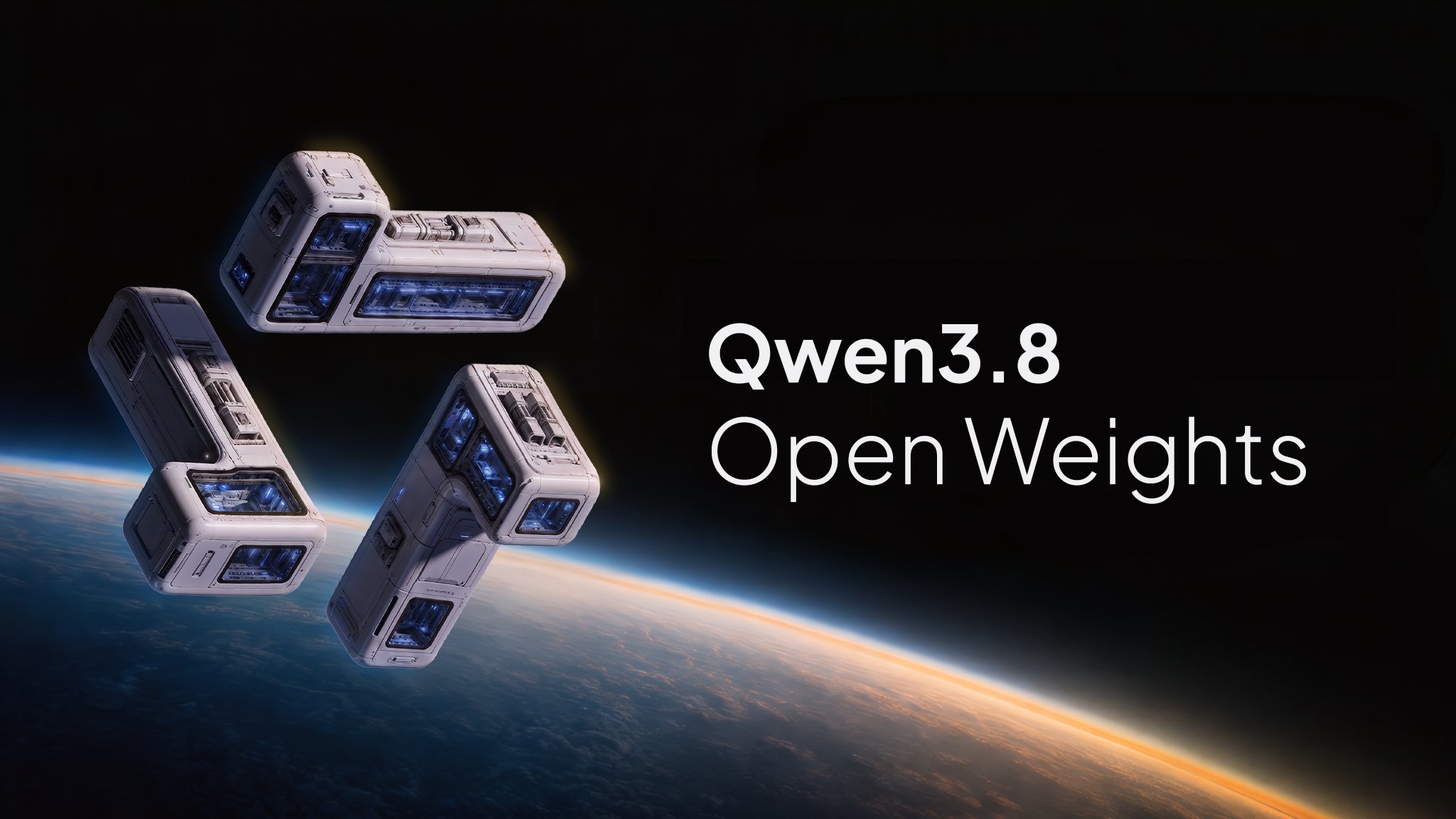
While everyone’s watching the trillion-parameter arms race, Alibaba just did something genuinely useful: it released Qwen3.8-27B as open weights on Hugging Face under an Apache 2.0 license. No API. No subscription. No revenue-share clause. Just a 27-billion-parameter model you can download and run on hardware you already own.
This is the kind of release that matters more to a small business than any flagship demo.
What actually shipped
Alibaba announced Qwen3.8-Max — its 2.4-trillion-parameter flagship — on August 3. The headline grabber was the massive model. The practical half of the announcement was the Qwen3.8-27B companion, promised as open weights within a week. It arrived August 13-14 on Hugging Face and ModelScope.
What you get: a dense 27B-parameter model that inherits the 3.8 generation’s improvements in coding, reasoning, and agentic work, distilled into a package that fits on a single GPU. It’s multimodal out of the box — text, images, and video — with autonomous planning and multi-step task execution built in.
The small business case in three sentences
It runs on hardware you can afford. At 4-bit quantization, the model loads into roughly 17GB of VRAM. That means a single RTX 4090 (24GB), a Mac Studio with Apple Silicon, or a rented cloud GPU instance can serve it. No cluster. No 50,000 server rack. No negotiating with Alibaba’s sales team.
Your data never leaves your machine. For businesses handling client contracts, financial records, medical files, or anything covered by GDPR, HIPAA, or just basic professional discretion, self-hosting means zero third-party access. The model runs on your infrastructure. Your prompts stay on your hard drive.
There is no meter running. API pricing for frontier models adds up fast. A small agency doing document review, code assistance, or customer support automation can burn through thousands in tokens per month. With an open-weight model, you pay for the hardware once — or rent a GPU for cents per hour — and generate as much as you need.
What it can actually do for you
Based on the lineage and confirmed capabilities, Qwen3.8-27B is positioned for:
- Document processing — extracting data from PDFs, contracts, and reports without sending them to a cloud API
- Coding and prototyping — the Qwen 3.6-27B predecessor was a community favorite for local coding assistance; this generation should improve on that baseline
- Agentic workflows — autonomous planning and multi-step execution for tasks like research, data aggregation, or status reporting
- Multimodal analysis — understanding images, diagrams, and video content for fields like architecture, engineering, or retail inventory
The model also includes “thought-control,” letting you dial the depth of reasoning up or down depending on whether you need a quick answer or a thorough analysis.
The honest caveats
You need a real GPU. A 27B model at 4-bit quantization needs 17GB of VRAM, and that’s before the KV cache for context. An RTX 4090 (24GB) should handle it comfortably. A laptop with integrated graphics will not. If your business doesn’t already have a workstation-grade machine, budget for one or rent a cloud GPU.
It’s not the flagship. The 2.4T-parameter Qwen3.8-Max is a different class of model, and this 27B version is deliberately smaller. For most day-to-day business tasks — drafting, analysis, extraction, coding — the gap is smaller than the parameter count suggests. For frontier research or massive context tasks, you’ll still want the API.
The ecosystem is still catching up. Community quantization builds (GGUF, AWQ) will land within hours or days, but production serving stacks need a reference implementation. If you’re not comfortable with vLLM, llama.cpp, or similar tools, there’s a learning curve.
The bigger picture
This release continues a pattern that should matter to any business evaluating AI strategy: the gap between “open weights” and “good enough” is closing faster than the gap between “API-only” and “affordable.”
Alibaba’s 2.4T flagship is API-only and reportedly carries a revenue-share license for large commercial users. The 27B model is Apache 2.0 and runs on your desk. That split — flagship for cloud, compact for local — is becoming the standard playbook. DeepSeek, Meta, and Mistral have all shipped similar tiers.
For a small business, the message is clear: you no longer need to rent intelligence by the token. You can own it.
Bottom line
If you’ve been holding off on AI because of privacy concerns, API costs, or vendor lock-in, Qwen3.8-27B is worth a serious look. It’s not a magic wand, and it won’t replace a human strategist. But it is a capable, self-hosted assistant that runs on realistic hardware, costs nothing per query, and keeps your data where it belongs.
Download it. Test it on your actual documents, your actual code, your actual workflows. Measure the output. If it saves you two hours a week, it pays for the GPU in a month.
That’s the kind of AI news that actually belongs in a small business budget meeting.
Want help setting up local AI for your business?
Get in touch — we build systems that stay on your hardware.
Leave a Reply