FROM THE EDITORS
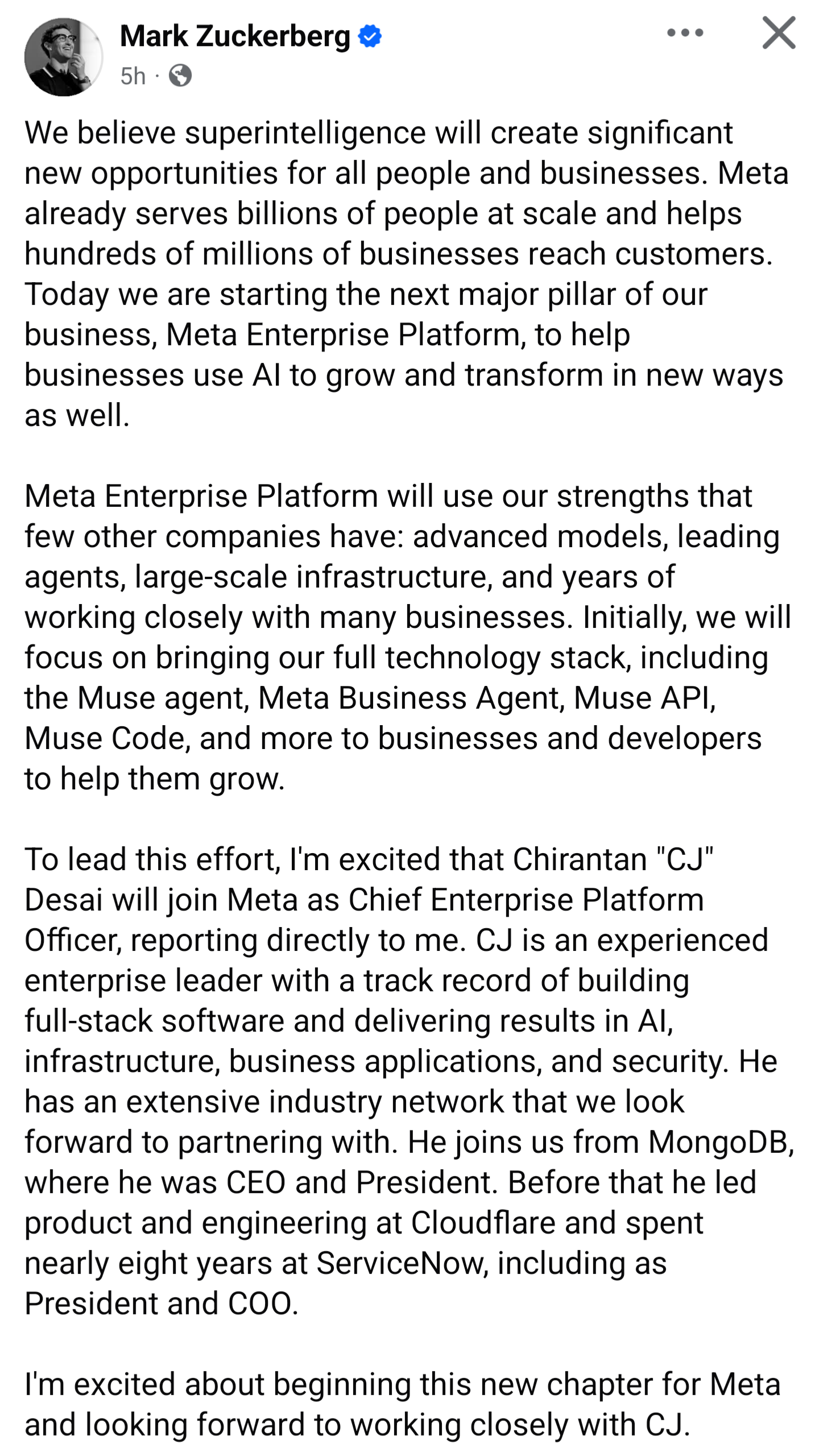
On Monday morning, Mark Zuckerberg called it the next major pillar of Meta.
In a post on September 28, 2026, he announced the Meta Enterprise Platform, a new business unit to help companies use AI to grow. It will be led by Chirantan “CJ” Desai, former CEO and President of MongoDB, as Chief Enterprise Platform Officer reporting directly to Zuckerberg.
Meta describes it as the next major pillar alongside its consumer apps and advertising business.
The name says enterprise, but if you run a small business in the EU, this one is worth reading closely.
What Meta actually announced
The Enterprise Platform isn’t a single product. It’s Meta packaging its full AI stack for businesses and developers. Initially that means:
- Muse agent: Meta’s personal AI agent, a persistent, context-aware assistant that remembers context across sessions and is designed to act, not just chat.
- Meta Business Agent: The customer-facing agent that lives in WhatsApp and Messenger.
- Muse API: Developer access to Meta’s models.
- Muse Code: Meta’s coding agent.
The pitch, in Zuckerberg’s words from the announcement, is to use strengths “few other companies have: advanced models, leading agents, large-scale infrastructure, and years of working closely with many businesses.”
The toolkit in plain English for a small business
Forget the enterprise jargon. Here’s what each piece could mean for a 5 to 50 person company.
Meta Business Agent answers customers, recommends products, books appointments and qualifies leads. Example: A Copenhagen bike shop auto-answers “Do you have this in size M?” in Danish and English at 22:30, then books the service slot.
Muse agent does tasks for you, not for your customers. It drafts supplier emails, compares shipping options, and turns a voice note into a step-by-step plan.
Muse API lets developers build Meta AI into your own systems. Example: Signal Digital could connect your webshop FAQ directly to Meta’s models.
Muse Code helps build and maintain software faster. Example: Your freelancer ships that booking integration in days, not weeks.
The Business Agent is already the most relevant for SMEs.
That’s the distribution advantage. Your customers are already there.
Why this matters more for EU small businesses than it looks
- You live where Meta lives.
EU small businesses don’t run on email alone. They run on WhatsApp chats, Instagram DMs, and click-to-message ads. Meta is bringing AI to that exact surface, not to some new enterprise dashboard you have to learn. - It lowers the automation floor.
Until now, useful AI agents meant custom builds. A packaged Business Agent plus an API means a hair salon in Aarhus or a D2C brand in Berlin can get 80% of the value with configuration, not code. - Multilingual is built in.
For EU businesses serving customers in two or three languages by default, an agent that can switch between Danish, English, German or French without hiring extra staff is not a nice to have. It’s margin.
In short: this is Meta moving from “we help hundreds of millions of businesses reach customers” with ads, to “we help them serve customers” with agents.
The EU reality check: AI Act and GDPR
If you operate in the EU, you can’t just switch this on like in the US. Two things to get right from day one:
Transparency is now law. The EU AI Act’s transparency rules went live on August 2, 2026. If your business uses AI in customer communication, you now have compliance obligations.
Specifically, Article 50 requires providers and deployers to ensure people know when they’re interacting with AI, and that certain AI-generated content is disclosed. For you, that means a simple, clear disclosure in the chat: “You’re chatting with our AI assistant.” No dark patterns.
Fines are real. The high-risk provisions became enforceable on August 2, 2026, with penalties reaching 15 million euros or 3 percent of global annual turnover. Most small businesses won’t be building high-risk systems, but you sit in the supply chain, and obligations will reach you via Meta’s terms and your own customer contracts.
GDPR still applies. An agent that reads bookings, purchase history or health-adjacent data needs a lawful basis, data minimization, and clear retention. Ask where data is processed, how long it’s stored, and whether human review is possible.
This isn’t a reason to wait. It’s a reason to deploy cleanly.
What to do next: 3 moves for EU SMEs
- Start with one WhatsApp use case.
Don’t boil the ocean. Pick the repetitive conversation that eats your team’s mornings: opening hours, pricing, “is this in stock?”, appointment rescheduling. Pilot the Meta Business Agent there, with AI disclosure built into the welcome message. - Connect it to your real systems.
An agent is only as good as its answers. Link it to your booking system, inventory sheet or help center before you worry about tone of voice. The Muse API is where agencies like Signal Digital can help you do this without rebuilding everything. - Document like you’ll be audited.
Keep a one-pager: what the agent does, what data it touches, how a human takes over, and where your disclosure lives. That’s good customer trust and good AI Act hygiene.
Meta is betting that superintelligence will create new opportunities for all businesses, not just big tech. For EU small businesses, the opportunity isn’t abstract. It’s answering faster, selling in more languages, and automating the admin that keeps you from the work you actually want to do.
The winners won’t be the companies with the biggest AI budgets. They’ll be the small teams that deploy one useful agent, compliantly, and learn fast.
Want help scoping your first use case? At Signal Digital we help EU small businesses turn Meta’s new tools into practical, GDPR-aware growth. Get in touch for an agent audit.
This article is for information only and is not legal advice on the EU AI Act or GDPR.
Leave a Reply