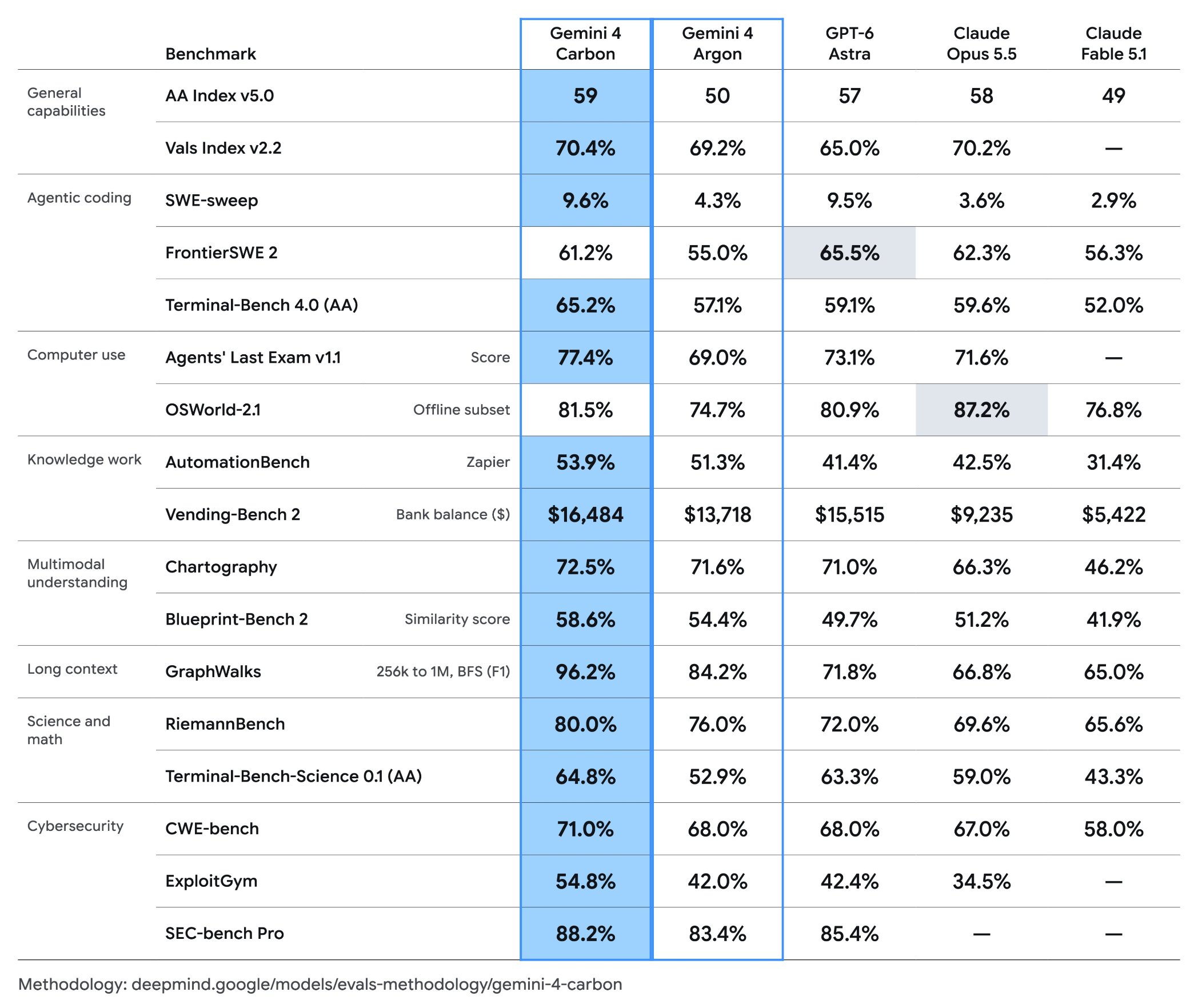
Google’s new top model, Gemini 4 Carbon, leads most benchmarks in the table. Almost nobody can use it yet: it goes to cyber defenders first, and a small business may wait some time before it reaches the shop floor.
FROM THE EDITORS
A jeweller puts the best stone in the window, under glass, with no price tag. Everyone can look. Nobody can take it home yet. That is roughly where Google’s newest model sits this week.
What was announced
On 28 October Google introduced Gemini 4 Carbon, which it calls its strongest frontier model. It comes only two weeks after Gemini 4 Argon. “I did say we’d be releasing our models periodically,” wrote Sundar Pichai on X.
The rollout has three stages. First, a small group of trusted cyber defenders gets access this week. Then access widens to more partners through the Fairwind Program, Google DeepMind’s early-access scheme for high-priority defenders such as governments, hospitals and telecoms operators. Only after that, once guardrails have been refined, will Carbon reach developers, businesses and consumers. Google has not given a date. Pichai’s advice was: “hang tight”.
What the table says
Google’s benchmark table compares Carbon with Argon, OpenAI’s GPT-6 Astra, and Anthropic’s Claude Opus 5.5 and Claude Fable 5.1. Carbon has the best score in 15 of the 17 rows. It ranks first on the Artificial Analysis Intelligence Index v5.0 at 59, one point ahead of Claude Opus 5.5 (58) and two ahead of GPT-6 Astra (57).
The rows that matter most for ordinary office work are interesting. On AutomationBench, built with Zapier to test the kind of multi-app workflows a small firm runs every day, Carbon scores 53.9% against 42.5% for Claude Opus 5.5 and 41.4% for GPT-6 Astra. On Vending-Bench 2, where a model runs a simulated small business, Carbon ends with a bank balance of $16,484, against $15,515 for GPT-6 Astra and $9,235 for Claude Opus 5.5.
It does not win everything. GPT-6 Astra leads FrontierSWE 2 (65.5% against 61.2%), and Claude Opus 5.5 leads OSWorld-2.1, a test of operating a computer (87.2% against 81.5%). And these are Google’s own figures, picked by Google. Independent tests will follow.
Why it is behind glass
The reason for the slow rollout is cybersecurity. Carbon scores 88.2% on SEC-bench Pro for finding vulnerabilities, 54.8% on ExploitGym for showing whether they can be exploited, and 71.0% on CWE-bench for patching them. A model that is very good at finding and fixing holes is also good at using them. So the defenders get it first.
Google also reports better behaviour. On Terminal-Bench 4.0, successful cheating dropped to 0.0%. High-severity misalignment alerts in its internal coding environments fell by almost 80%. And on the Gray Swan benchmark for indirect prompt injection, which tests whether hidden instructions in a web page or document can hijack the model, the attack success rate was 0.0%, against 0.7% for Argon. For a small firm that lets an AI read its inbox, that last number is the one to watch.
What it means for a small business
Not much this month, and that is fine. The useful signals are elsewhere.
The first is price. Carbon will launch at the same introductory price as Argon, $2 per million input tokens and $10 per million output tokens, with cached input 95% cheaper. After the introductory period the price doubles to $4 and $20. That is still a frontier price. For most everyday tasks, a cheaper model will do the job.
The second is pace. Two frontier models from one lab in two weeks means the tools a small firm buys today will be overtaken quickly. Build your workflows so you can swap the model underneath them, rather than tying yourself to one.
The third is security. When the best models go to defenders first, it is a reminder that attackers use AI too. The basics, patching, multi-factor login and backups, matter more than ever.
What to do this week
- Do not wait for Carbon. The models you already have access to are more than good enough for writing, summaries, translation and customer service.
- Keep the model swappable. If you use an AI tool or an automation platform, check that you can change the underlying model without rebuilding everything.
- Note the price step. If you plan to use Carbon when it arrives, budget for the $4/$20 price, not the introductory one.
- Tighten the basics. Update software, turn on multi-factor login for every account, and test that your backups actually restore.
The diamond is in the window. One day it will be on the counter, and probably cheaper than it is today. Until then, the tools on the shelf will do the work, and the shop is still yours to run.
Sources
- Google, “Introducing Gemini 4 Carbon”, 28 Oct 2026 — https://blog.google/innovation-and-ai/models-and-research/gemini-models/introducing-gemini-4-carbon/
- Sundar Pichai on X, 28 Oct 2026 — https://x.com/sundarpichai
- Unite.AI, “Staged Rollout Sends Google’s Gemini 4 Carbon To Cyber Defenders First” — https://www.unite.ai/staged-rollout-sends-googles-gemini-4-carbon-to-cyber-defenders-first/
- 9to5Google, “Google announces Gemini 4 Carbon” — https://9to5google.com/2026/10/28/gemini-4-carbon-announcement/
Leave a Reply