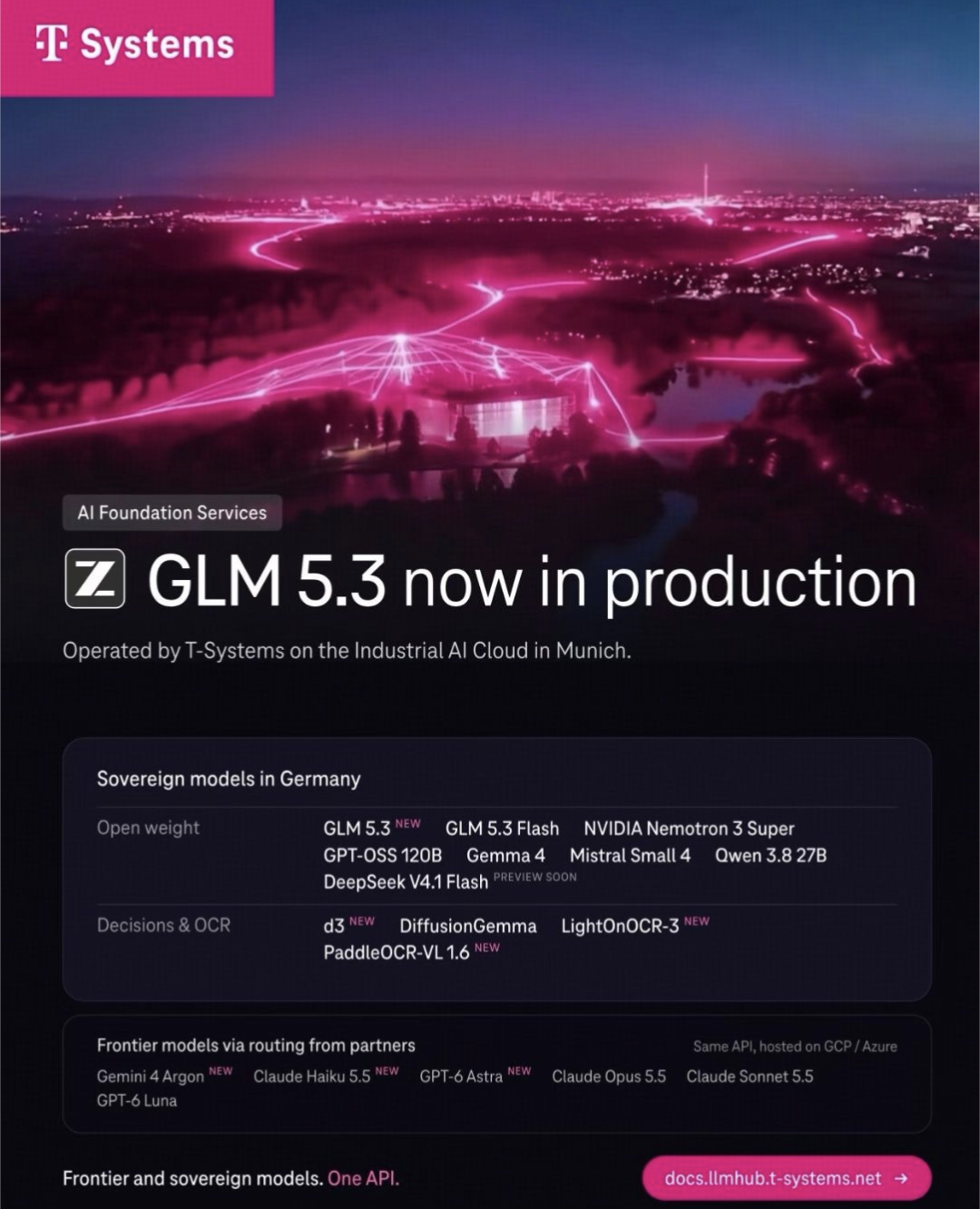
T-Systems now runs GLM 5.3, Z.ai’s open-weight model, in production on its Industrial AI Cloud in Munich. It sits alongside Mistral, Gemma, Qwen and others, all behind one OpenAI-compatible API. For EU small firms, the useful part isn’t one more model. It’s a clear line between AI that runs in Germany and AI that is only routed through a German front door.
FROM THE EDITORS
Think of two ways to get a good meal. You can order from a famous restaurant abroad, and the food arrives on someone else’s terms. Or you can take the recipe and have it cooked in a kitchen down the road, with your own ingredients that never leave the building. Open-weight models are recipes. T-Systems has opened a large kitchen in Munich and is cooking some of the best recipes from China, the US and France there. It also takes delivery orders for the famous restaurants, through the same counter. Knowing which is which is the whole story.
What changed. T-Systems’ AI Foundation Services, also called LLM Hub, now serves GLM 5.3 in production. Its predecessor, GLM 5.2, ran there as a free private preview from July. Carol Lin, Z.ai’s CEO for global business, called the deal a way to bring GLM “to more European enterprises, with local deployment in Germany”. The model runs on Deutsche Telekom’s Industrial AI Cloud in Munich, built with NVIDIA, which opened in February 2026 with about 10,000 GPUs.
The “sovereign” list now covers more than 30 models, including GLM 5.3 and GLM 5.3 Flash (Z.ai, China), Mistral Small 4 (Mistral AI, France), Gemma 4 (Google, US), Qwen 3.8 (Alibaba, China), GPT-OSS 120B (OpenAI, US) and Nemotron (NVIDIA, US), plus OCR models such as LightOnOCR-3. Through the same API, T-Systems also routes requests to partner models from OpenAI, Google and Anthropic, among them Claude Sonnet 5.5 and Opus 5.5.
The kitchen and the delivery counter. T-Systems’ own documentation splits its models into two categories, and the difference matters more than any benchmark.
- Category 1, cooked in Munich: open models run on T Cloud in Germany. T-Systems says prompts and answers are not permanently stored, not visible to Telekom or anyone else, and not used for training. The platform lists ISO 27001, BSI C5 Type 2, SOC 2 Type II and TISAX certifications.
- Category 2, delivered from elsewhere: partner models run on Google Cloud or Microsoft Azure. Here the provider’s own terms apply, Telekom’s zero-retention promise does not, and processing may take place worldwide. Some models are pinned to European regions, such as Azure in Sweden, while several Gemini and Claude Haiku models are listed as “worldwide”.
One API for both is convenient. It also means a developer can switch from a German-hosted model to a worldwide one by changing a single model name. For a firm handling customer data, that switch should be a decision, not a typo.
The price of a local kitchen. The per-token prices for the open models are low. GLM 5.3 Flash costs €0.20 per million input tokens and €0.60 per million output tokens. The full GLM 5.3 costs €1.40 and €4.40, with a 1-million-token context window. For comparison, routed Claude Sonnet 5.5 is listed at €2.97 and €14.85.
The catch for small firms is the entry ticket. Shared plans start with a monthly minimum spend of €1,000 (Essential), rising to €3,000 and €5,000 for higher throughput. A free trial key unlocks all models, but there is no published pay-as-you-go plan. A five-person firm that uses AI for a few hundred emails and documents a month will not get near €1,000 in tokens. For now, this is a service for larger SMEs, for software firms building products for others, and for groups of firms sharing access.
The fair questions. Three objections deserve space.
First, “sovereign” is the vendor’s word. The certifications are real and the documentation is unusually clear, but the binding promises sit in the service description and the data processing agreement, which T-Systems offers on request. Read them, especially if you handle health or social data, which T-Systems itself notes may not leave the EU.
Second, the recipe’s origin. Z.ai is the international brand of Beijing-based Zhipu AI. Running the weights in Munich means your data does not travel to China. It does not change how the model was trained or what it was trained on. Some firms will care about that, and they can choose Mistral or Gemma from the same list.
Third, lock-in. The OpenAI-compatible API is a strength here: code written for LLM Hub can be pointed at another provider with little change. Keep it that way by not depending on features only one host offers.
Why it still matters. For years, the choice for a European firm was frontier quality from a US cloud, or local hosting with weaker models. Open-weight models like GLM 5.3 narrow that gap, and a German operator running them at scale makes the local option practical. Routing each job to the right model is becoming as important as picking the vendor. LLM Hub adds a second routing question: not just which model, but which kitchen.
What to do this month
- Get the free trial key and test GLM 5.3 Flash and Mistral Small 4 on a real task, such as summarising supplier PDFs or drafting customer replies.
- If you go further, ask for the data processing agreement and the service description before sending any personal data.
- Decide which models your team is allowed to use and keep the list to Category 1 for customer data. Write it down.
- If €1,000 a month is too much, ask your IT partner or software supplier whether they already buy access you can share.
Sources
- T-Systems, AI Foundation Services documentation — https://docs.llmhub.t-systems.net/
- T-Systems, AI Foundation Services plans and prices — https://docs.llmhub.t-systems.net/plans/
- T-Systems, Enterprise trust and data handling — https://docs.llmhub.t-systems.net/reference/enterprise-trust/
- T-Systems, “GLM 5.2 private preview” (Andrej Schreiner, 2 July 2026) — https://ai.t-systems.net/en/blog/glm-5-2-private-preview
- T-Systems, Industrial AI Cloud — https://www.t-systems.com/industrial-ai-cloud
- Carol Lin (Z.ai), LinkedIn announcement of GLM-5.3 on T-Systems’ Industrial AI Cloud, November 2026
Leave a Reply