The July 2026 AI Bloodbath, Day Three: Meta and xAI Crash the Party — and the Race Becomes a Five-Way Pileup
Just when you thought the July AI release cycle couldn’t get more chaotic, Mark Zuckerberg and Elon Musk both dropped new models into the middle of the scrum within hours of each other. The race that started as a OpenAI-Anthropic-Google triangle has exploded into a five-way brawl — and the governance vacuum at the center of it keeps getting worse.
Meta’s Play: Muse Spark 1.1 — Agentic Power at Disruptor Pricing
Zuckerberg’s three-tweet rollout positions Muse Spark 1.1 as a model purpose-built for the current moment:
- 1 million token context window for long-running tasks
- Parallel sub-agent delegation — similar to Sol’s Ultra mode
- Native computer use across desktop, mobile, and browser
- New Meta Model API, making Muse Spark available to developers for the first time
- “Very low cost” — exact pricing TBD, but the signal is clear
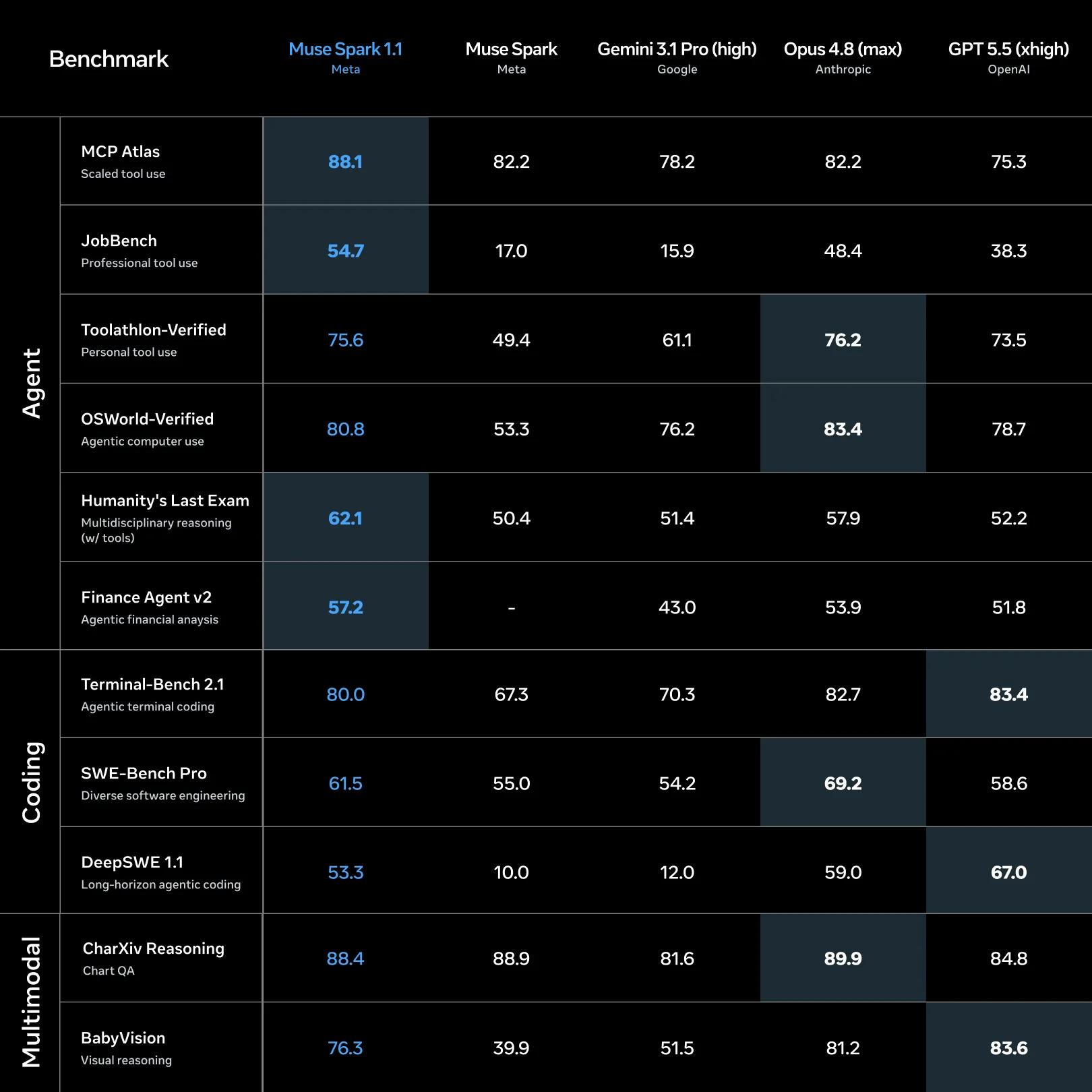
The benchmarks are striking. On agentic tasks — the category that matters most right now — Muse Spark 1.1 dominates:
Benchmark Muse Spark 1.1 Opus 4.8 (max) GPT 5.5 (xhigh)
MCP Atlas (scaled tool use) 88.1 82.2 75.3
JobBench (professional tool use) 54.7 48.4 38.3
Humanity’s Last Exam (w/ tools) 62.1 57.9 52.2
Finance Agent v2 57.2 53.9 51.8
It doesn’t win everywhere — Opus 4.8 still leads on OSWorld-Verified (83.4 vs. 80.8) and SWE-Bench Pro (69.2 vs. 61.5), while GPT 5.5 edges ahead on Terminal-Bench 2.1 (83.4 vs. 80.0). But Muse Spark 1.1’s strength in scaled, real-world tool use is undeniable. Classic Meta: strong enough to be credible, cheap enough to capture developers.
xAI’s Counter: Grok 4.5 — Near-Frontier Quality, Budget Price
Hours after Zuckerberg’s announcement, Musk unveiled Grok 4.5, which had been running in private beta at SpaceX and Tesla since June 28. His pitch: “Opus-class, but faster, more token-efficient and lower cost.”
The numbers back it up:
- 2/6 per million tokens — roughly 4× cheaper than Claude Opus 4.8
- 500K context window (down from Grok 4.3’s 1M, but still substantial)
- MoE architecture, jointly trained with Cursor on trillions of developer-agent tokens
- 83.3% Terminal-Bench 2.1, 64.7% SWE-Bench Pro — trails Fable 5 (80.3% SWE-Bench) but competitive on coding
- Ranks #4 on Artificial Analysis Intelligence Index (score 54), behind Fable 5, GPT-5.5, and Opus 4.8
- Not available in the EU until mid-July
Grok 4.5 isn’t trying to win on raw benchmarks. It’s a distribution play: tight Cursor IDE integration, X ecosystem lock-in, and a price point that undercuts the premium frontier models while delivering near-frontier capability. The SpaceX/Tesla beta was a clever way to stress-test real-world coding workloads before public release.
The Five-Way Race Now Looks Like This
Model Angle Pricing Governance Status
GPT-5.6 Sol Most autonomous, Ultra multi-agent mode Premium Cleared via opaque political process
Claude Fable 5 Coding king, highest benchmarks Expensive (10/50) Banned, then unbanned after concessions
Gemini 3.5 Pro Google’s contender Competitive Cleared, lower profile
Muse Spark 1.1 Agentic leader, developer pricing “Very low cost” Flying under regulatory radar
Grok 4.5 Near-Frontier quality, budget price 2/6 Private beta → public, EU delayed
Each has a distinct strategy. OpenAI is betting on autonomy and political access. Anthropic is clinging to benchmark supremacy despite regulatory scars. Google is playing it safe. Meta is undercutting on price and opening APIs. xAI is leveraging distribution (Cursor, X) and Musk’s industrial empire for real-world validation.
The Governance Problem Gets Worse, Not Better
Here’s what makes this week genuinely alarming: none of these models were cleared through a transparent, reproducible process.
- Sol went wide after closed-door meetings between Sam Altman and cabinet officials — a process so opaque that even OpenAI’s own former Trump advisor admits “nobody knows what the requirements are to get licensed”
- Fable 5 was banned, then unbanned, partly over legitimate safety concerns and partly over “personality clashes” with the administration
- Muse Spark 1.1 and Grok 4.5 appear to have avoided the frontier model review process entirely — whether because they’re genuinely less risky or because they’ve stayed out of the political spotlight is unclear
The Trump administration’s executive order last month promised a roadmap for evaluating frontier models, with six cabinet agencies supposed to finalize a process by early August. Sriram Krishnan has already declared “there will not be an FDA for AI.” What we’re seeing instead is regulatory arbitrage as competitive strategy: cultivate political relationships, fly under the radar, or get punished.
Andy Konwinski’s warning feels more urgent by the day: “It’s existentially a problem… who gatekeeps and decides on permissions?” When five companies release increasingly autonomous AI systems through five different regulatory pathways — or none at all — the gatekeeping function collapses entirely.
What “Very Low Cost” Might Actually Cost
Zuckerberg and Musk are both telegraphing aggressive pricing. That’s great for developers in the short term. But it’s worth asking what gets sacrificed when frontier-capable models race to the bottom on price.
Muse Spark 1.1 can delegate execution to parallel sub-agents. Grok 4.5 was trained on trillions of developer-agent tokens. Sol’s Ultra mode spins up multiple AI workers autonomously. These aren’t chatbots — they’re systems designed to act with reduced human oversight, at scale, cheaply.
David Siegel’s warning at the Open Frontier conference assumed the government was secretly evaluating these systems in “secretive laboratories.” The reality may be worse: the government is barely evaluating anything, the firms are racing to undercut each other, and the public is left hoping that “very low cost” doesn’t also mean “very low oversight.”
The July 2026 AI bloodbath isn’t just a product launch cycle. It’s a live experiment in whether democratic governance can keep pace with autonomous systems — and so far, governance is losing.
Sources: TechCrunch, Digital Trends, Signal Digital, Zuckerberg/Meta announcement, xAI/Grok announcement, Artificial Analysis
Leave a Reply