FROM THE EDITORS
August 15, 2026
A geopolitical fault line is opening in artificial intelligence — and if you run a small or medium-sized business in Europe, you’re standing right on it.
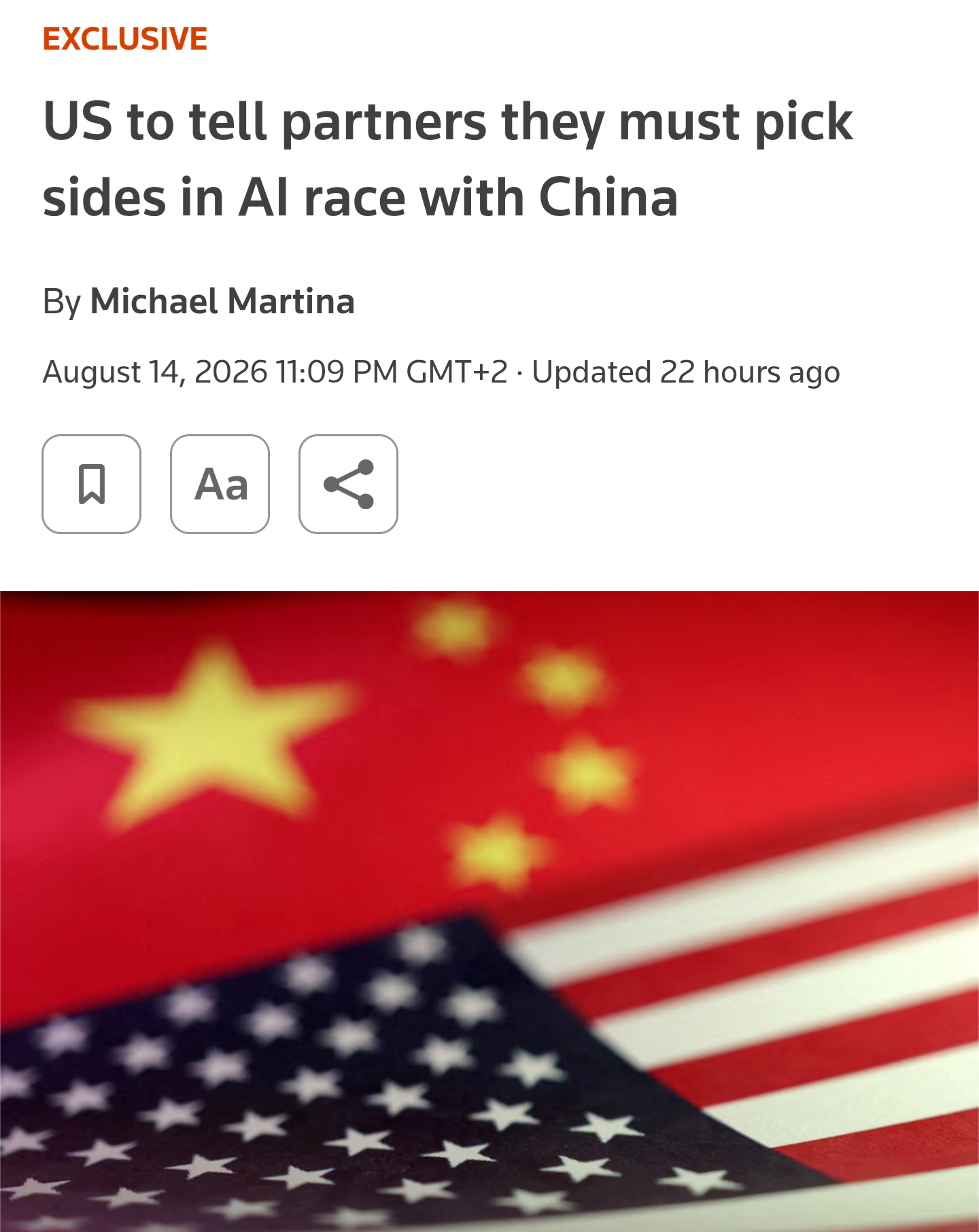
According to a recent Reuters report, the United States is now telling its partners and allies that they must pick a side in the escalating AI race with China. This isn’t abstract diplomacy. For EU small businesses, it translates into real decisions about the tools you use, the platforms you build on, the data you trust, and the markets you can access.
Here’s what this shift means — and how to navigate it without getting crushed between superpowers.
- The “Pick a Side” Moment Is No Longer Theoretical
For years, European businesses could operate in a kind of technological neutrality. You might use American cloud infrastructure, Chinese hardware components, and European data regulations — all at once. That era is ending.
The US is now explicitly linking AI cooperation to alignment against Chinese technology. This means:
- Export controls and investment screening are tightening. If your business relies on Chinese-manufactured semiconductors, AI chips, or certain software components, supply chains are becoming less predictable and more expensive.
- Cloud and model dependencies matter politically. Using a Chinese large language model or hosting data on Chinese-affiliated infrastructure may soon carry reputational, legal, or contractual risks — especially if you work with US partners or government-adjacent clients.
- “De-risking” is becoming mandatory, not optional. The EU itself has labeled China a “systemic rival” and is pushing for technological sovereignty. Small businesses are now expected to demonstrate supply chain resilience and data integrity in ways that previously only concerned multinationals.
- The EU AI Act Just Became Your Geopolitical Shield — and Your Burden
The EU AI Act, fully applicable since August 2026, already imposes strict compliance requirements on businesses using high-risk AI systems. But in this new geopolitical climate, it serves a second function: it is Europe’s answer to both American dominance and Chinese influence.
For small businesses, this creates a dual pressure:
- Compliance costs are rising. SMEs must now document AI transparency, conduct risk assessments, and ensure human oversight — all without the legal departments that large tech firms maintain.
- “European AI” is becoming a market differentiator. Customers, investors, and B2B partners are increasingly asking: Is your AI stack compliant, auditable, and free from geopolitical entanglement? Businesses that can answer “yes” gain trust. Those that can’t may lose contracts.
The irony? The EU’s push for “strategic autonomy” could fragment the global AI market into competing blocs — making it harder and more expensive for small businesses to access the best tools at the best prices.
- Your Cloud Bill and Your AI Vendor Are Now Political Choices
Small businesses in the EU typically rely on a handful of major providers for AI infrastructure: Amazon Web Services, Microsoft Azure, Google Cloud, and increasingly, European alternatives like OVHcloud or Aleph Alpha.
The US-China divide forces a reckoning:
- American platforms are safe politically (for now) but dominant. Relying entirely on US-based AI models means exposure to American regulatory whims — like sudden chip export bans or changes to API access terms.
- Chinese platforms are cheap but risky. Tools like DeepSeek or Alibaba Cloud offer competitive pricing, but using them may soon trigger compliance headaches, client objections, or even sanctions-related liability.
- European alternatives are emerging but immature. Sovereign AI initiatives and GDPR-compliant European models are growing, but they often lack the scale, speed, and ecosystem of their American counterparts.
The practical implication: SMEs must now treat vendor selection as a strategic risk decision, not just a procurement choice. Diversification — using multiple providers, keeping critical data in European jurisdictions, and maintaining fallback options — is no longer paranoid. It’s prudent.
- Talent and Knowledge Are Fragmenting
AI talent is global, but the US-China rivalry is nationalizing it. Visa restrictions, research partnerships, and IP protections are making it harder for knowledge to flow freely across borders.
For EU small businesses, this means:
- Hiring is getting harder. The best AI engineers are being pulled into national security-adjacent roles or mega-corporations with clear geopolitical alignment.
- Training gaps are widening. If your team learns AI through American or Chinese educational platforms, the curricula may increasingly reflect national priorities rather than universal best practices.
- European AI education is catching up, slowly. Investment in local AI skills — through initiatives like the European AI Innovation Board and national digital academies — is rising, but SMEs must invest in upskilling now or fall behind.
- Opportunities for Agile EU Small Businesses
It’s not all bad news. Geopolitical fragmentation creates niches that small, agile businesses can exploit:
- “Sovereign AI” consulting and implementation. Businesses that help other SMEs navigate compliance, choose European-compliant tools, and build audit-ready AI systems will find strong demand.
- Localization and cultural adaptation. As global AI models struggle with European languages, regulations, and cultural contexts, there is room for local players to build specialized, compliant solutions.
- B2B trust arbitrage. In a world where no one trusts the superpowers, being a transparent, compliant, mid-sized European operator is a competitive advantage. You are big enough to deliver, small enough to be accountable.
What Should EU Small Businesses Do Right Now?
- Audit your AI stack. Know where your models, chips, and data live. Map dependencies on US and Chinese technology.
- Diversify vendors. Don’t let a single geopolitical shock take your business offline. Maintain relationships with European, American, and (where legally viable) alternative providers.
- Treat the AI Act as an asset, not just a cost. Build compliance into your product from day one. Market it as a trust signal.
- Invest in local talent. Partner with European universities, join national AI clusters, and train your existing team on sovereign AI tools.
- Stay informed, not panicked. Geopolitics moves slowly until it doesn’t. Monitor regulatory changes, but don’t make rash technology decisions based on headlines alone.
The Bottom Line
The US demand that allies pick sides in the AI race is not just a diplomatic story. It is a business story — one that reaches into your cloud contract, your software vendor, your hiring plan, and your compliance checklist.
For EU small businesses, the path forward is neither pure alignment with Washington nor naive openness to Beijing. It is strategic European pragmatism: using the best tools available, complying with the world’s strictest AI regulations, and building resilience into every layer of your technology stack.
The businesses that master this balance will survive the fragmentation. The ones that ignore it may find themselves on the wrong side of a border they never saw coming.
Signal Digital helps European SMEs navigate AI adoption, compliance, and digital strategy. Get in touch to assess your AI stack’s geopolitical readiness.
Leave a Reply